Pink Brain Blue Brain

The other day I was talking to someone about gender whose career in early childhood education has spanned decades. She said, “but there are real differences between girls and boys – I hear it and see it all the time.” I argued that even at age 3 messages of gender roles have been so reinforced that is has greatly shaped what she is seeing — for the most part, of course there are some brain differences between boys and girls.  Dr.Lise Eliot’s book Pink Brain Blue Brain explores this, on her website Pink Brain Blue Brain is summarized as:

“How Small Differences Grow into Troublesome Gaps – and What We Can Do About It

In the past decade, we’ve heard a lot about the innate differences between males and females. So we’ve come to accept that boys can’t focus in a classroom and girls are obsessed with relationships: “That’s just the way they’re built.”

In Pink Brain Blue Brain, neuroscientist Lise Eliot turns that thinking on its head. Calling on years of exhaustive research and her own work in the field of neuroplasticity, Eliot argues that infant brains are so malleable that small differences at birth become amplified over time, as parents, teachers, peers—and the culture at large—unwittingly reinforce gender stereotypes. Children themselves exacerbate the differences by playing to their modest strengths. They constantly exercise those “ball-throwing” or “doll-cuddling” circuits, rarely straying from their comfort zones.

But this, says Eliot, is just what they need to do. And she offers parents and teachers concrete ways to help. Presenting the latest science from conception to puberty, she zeroes in on the precise differences between boys and girls, reining in harmful stereotypes. Boys are not, in fact, “better at math” but at certain kinds of spatial reasoning. Girls are not naturally more empathetic than boys; just allowed to express their feelings more.

Of course, genes and hormones play a role in creating boy-girl differences, but they are only the beginning. Social factors, such as how we speak to our sons and daughters and whether we encourage their physical adventurousness, are proving to be far more powerful than we previously realized. As a parent, Eliot understands the difficulty of bucking gender expectations, but also the value of doing so.

In an increasingly complex and competitive world, we need our boys to be emotionally intelligent and our girls to be technologically savvy. By appreciating how sex differences emerge—rather than assuming them to be fixed biological facts—we can help all children reach their fullest potential, close the troubling gaps between boys and girls, and ultimately end the gender wars that currently divide us.”

On Rabbits and Emotional Intelligence

What does a kitten and a dinosaur have to do with gender roles and the health of our children? Please, read on….

What message are we sending our children when we say kittens are gentle and are a “girl animal” and dinosaurs are fierce and are a “boy animal?” (This is of course one of countless examples, we assign everything to either boys or girls or male/ female). Furthermore, I find that girls are encouraged to stray from liking the animals traditionally assigned to their gender role, but there is much more resistance to supporting boys in doing this straying.

The rigid male gender role hurts of boys, period. Our boys need to know that all of their interests, emotions, and feelings are valid, important, and should be celebrated.

In a recent Psychology Today article Dr. John D. Rich Jr says, “girls are given license to express their emotions and be vulnerable with their friends in a way that may be ridiculed for a boy. A boy who is upset and cries may be told to ‘suck it up,’ or ‘be a man.’ A man who expresses anxieties or  depression may be ridiculed.” He goes on to explain that boys and men being driven to repress feelings and emotions this causes a host of negative outcomes, from depression to aggression & hostility.

How can we support our boys? There are lots of ways, below are two — I’ll be researching and collecting avenues to add to the blog.

First, talk about and explore constructed gender roles. Talk about it as a family, in schools, with boys and girls,* men and women, moms and dads, Dr. Rich notes “the approach that many counselors take with men is to help them reflect on the norms of masculinity which are behind their concerns, and to take a hard look at how a rigid adherence to those norms can damage men.”

Second, help boys heighten their emotional intelligence. Of the many things I want my son to learn, emotional intelligence is fundamental.

Emotional intelligence is our ability to identify, evaluate, and express emotions. Being emotionally intelligent helps us to use our feelings to identify and solve problems, and communicate and connect with others. Empathy is the ability to understand and care about others’ feelings and it is central to all relationships.

Here is some suggested resources to use in nuturing kids’ (and our own) emotional intelligence:

As Sesame Street says, “Feelings come in all shapes and sizes. When you help children express and understand their emotions, you’re helping them to overcome challenges, understand others, and communicate. In simple everyday ways, you can give them important tools that will help them handle big feelings, little ones, and every feeling in between.” Sesame Street in Communities website is brimming with resources.

Also check out Mark (Ruffalo) and Murray (the Muppet) explain empathy.

The Rabbit Listened by Cori Doerrfeld can teach both kids and the bigger people reading to them a lot about empathy. When Taylor’s block masterpiece is knocked down by an unexpected flock of birds he doesn’t want to take any of the visiting animals suggestions (get mad about it, remember how it was and quickly rebuild, knock down someone else’s masterpiece, pretend it didn’t happen) but when the rabbit hops over he just sits beside. He seeks to understand Taylor and in doing so gives Taylor the ability to cope with his loss and get excited to rebuild.

RabbitListened2

I am Human A Book of Empathy by Susan Verde and illustrated by Peter H. Reynolds is a beautifully illustrated journey helping little ones understand that “we can make good choices by acting with compassion and having empathy for others and ourselves.”

Robin Einzig’s Visible Child, you can find here website here and her Facebook page here.

I follow Visible Child on Facebook and am always excited to see an article hit my newsfeed. The articles cover a host of topics all with the same mission: how do we best support our children — and their adults.

Thanks for reading, please be in touch with your questions and thoughts.

*I will soon be posted about the important topic of gender beyond the binary.

“Another world is not only possible, she is on her way….”

A record-breaking number of women just joined congress and I couldn’t be more elated. These women are diverse in age, religion, race, ethnicity, and orientation — reflecting those they serve. In response to this historic new congress, I read a Facebook post of a woman who said she lives in a house full of boys who know women run the world. That’s a great thing! And, it leaves me wondering what role do boys and men have in the world? As an ardent feminist, what role do I want them to have? I am not certain of the answer (and certainly a collective response is needed) but I do know that I want our boys to both feel that they have a place & purpose and know how to give space to those who historically have been and consistently are denied it.

When I learned I was having a boy (or rather when the tech confirmed it, because I was certain) my first thought was: how am I going to raise a white male? During those countless gender conversations while pregnant I’d often hear “boys are easier.” And I would think, that depends on the boy’s race. I will never have to worry about my boy loosing his life because of the color of his skin. That so many mothers must live with this fear fills me with rage and an indescribable heartache. This must change.

It’s critical we have conversations about gender, race, and gender & race and that central to these conversations is how we support all of our children (girls, boys, and non-binary) in understanding their role in helping to create a more just world.

“Another world is not only possible, she is on her way. And on a quiet day, if you really listen, you can hear her breathing.” -Arundhati Roy

Looking for helpful, powerful, beautiful kid social justice books? Check out Innosanto Nagara, author of books for kids of the 99%.

Raising boys in the wake of #metoo

Our boys are listening and watching. When we send empowering messages to girls (as we should be), we must also speak to our boys. The question is, what do we them to hear and see?

Raising boys in the wake of #metoo

“Girls can do anything, right – but what about boys? Why do parents still get sideways looks when their boys wear a dress, or play with a doll? In the era of #MeToo this narrow definition of masculinity matter – and the roles we assign kids at birth can have devastating impacts, Cecile Meier discovers.”

Please read this powerful piece.

Today’s Masculinity Is Stifling

“As boys grow up, the process of becoming men encourages them to shed the sort of intimate connections and emotional intelligence that add meaning to life.

There are so few positive variations on what a “real man” can look like, that when the youngest generations show signs of reshaping masculinity, the only word that exists for them is nonconforming. The term highlights that nobody knows what to call these variations on maleness. Instead of understanding that children can resist or challenge traditional masculinity from within the bounds of boyhood, it’s assumed that they’re in a phase, that they need guidance, or that they don’t want to be boys.”

This important piece can be found here.

Clothes do matter

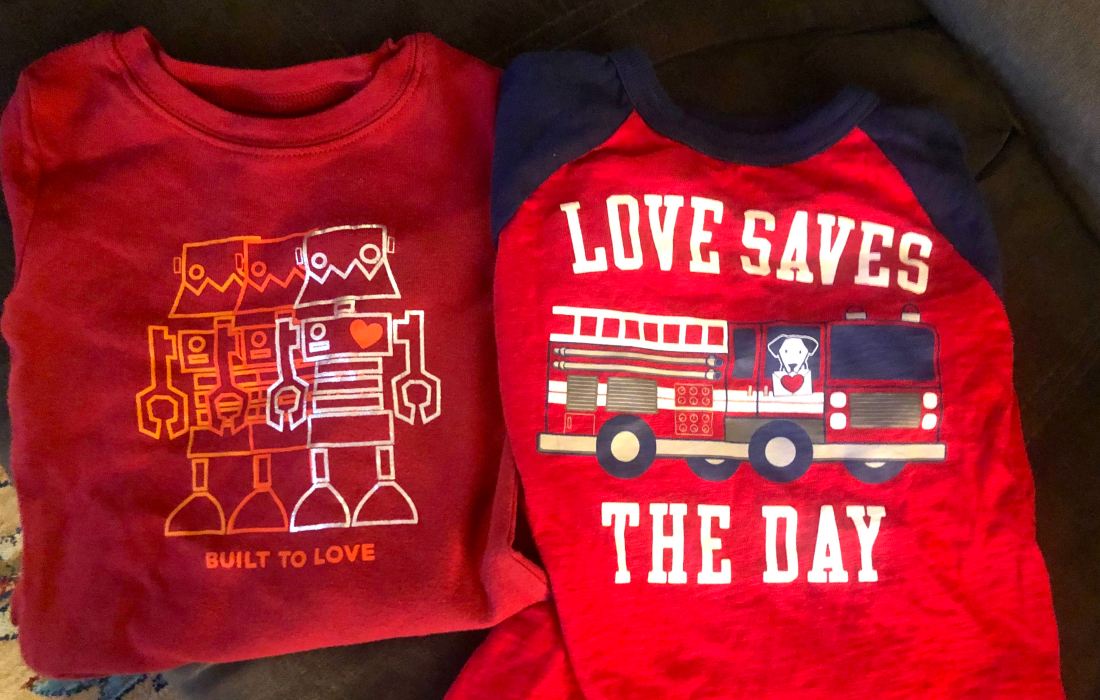
I recently bought 2 shirts from the “boy section” of mainstream clothing stores. One has robots and reads “built to love” and the other has a firetruck & dalmatian dog holding a heart and reads “love saves the day.” There are not usually 2 love options in the “boy section” but it’s close to Valentines Day. Here’s the thing: even with messages of love, the color remains red (or blue or gray) and the style remains the same boxy scoop neck.

Clothes are what we wrap our children in, and it matters that the choices designed for boys are greatly limited in content, style, and color. Today, the “girl section” is filled with many styles, images, and colors. You can choose from NASA, fierce animals or cuddly animals, “I am the future,” “Dream big,” pink dinos, hearts, rainbows, cupcakes – with every color represented.

You might be thinking, quit complaining and shop from the “girl section.” I do, sometimes, but it is hard because even as young as 6 months clothes designed for girls are cut differently – they are much smaller and fit differently.

Mitz Kids: Clever Clothes for Creative Kids strives to give more options within the realm of kids clothing.

Words from their website:

“We believe kids should be able to express their varying interests at all ages. Whether your little one is interested in dinosaurs, construction trucks, cooking or vegetables, boy or girl, there should be clothing available which allows them to showcase these interests. Mitz Kids makes children’s clothing that is designed with their interests in mind. Each piece of clothing is created to be developmentally appropriate for their age and reflects the changing interests. We also ensure that each design is free from gender stereotypes and can be worn by girls and boys!

When Co-Founder Amandine Liepmann’s daughter was just 15-months old, she became obsessed with dinosaurs. As a side project, Amandine made her daughter a dinosaur dress with spikes down the back to support her budding interest. When her daughter wore the dress it began conversations with other New York City parents about the lack of STEM-themed (Science, Technology, Engineering, and Mathematics) clothing choices for girls. She decided to put the dress on her company website and it sold out within hours.”

Amandine Liepmann says she does notice  resistance to putting boys in traditional “girl” colors. Noting, “We get a lot of homophobic comments [on our website], much more so than with any other girl posts. It’s more acceptable to introduce a girl to something traditionally masculine, but when you do the opposite: a boy can like the color pink or cats — boys love cats! — it seems like their heads explode.”

It matters that we only want our boys to express themselves in blue and red stripes and gray sharks. It matters when we say kittens are gentle and only for girls. It matters when a boy is interested in nature but confined only to wearing things with bug designs.

Clothes Without Limits, in their own words is: “a professional consortium of  13 independent childrenswear companies that challenge gender clichés in children’s clothing. We stand united in our belief that the options they see show them who they can be.

The entrepreneurs behind each company are all parents who began making children’s clothing because they felt the narrow selection of childrenswear available at mainstream retailers put limits on their children’s imaginations – and they decided to do something about it!”

Mitz Kids is joined by 12 other rad companies:

  • Baby Blastoff
  • Budding STEM
  • Clever Belle
  • Every Bean
  • Free To Be Kids
  • Girls Will Be
  • Handsome in Pink
  • Jessy & Jack
  • Jill and Jack Kids
  • Orange Clever
  • Princess Awesome
  • Quirkie Kids
  • Smarty Girl
  • Mitz Kids

Be sure to check out Mitz Kids blog and Clothes Without Limits website for meaningful commentary around these topics.

Two other places to head to:

Primary.com (score almost any solid color in all of the basic pants and tops you need)

Etsy.com (comprised of many different sellers making for endless search options: boho boys clothes, purple heart shirt, woodland harem pants, yoga panda bear romper)

I have a “boy clothes” Pinterest board if you’d like to check out some other finds.

The only drawback to many of these options is that they are more expensive than the $5 doorbusters you find at mainstream kid clothing stores. Of course those that hand-make and design clothes should be well compensated. Keep an eye out for sales by signing-up to receive email updates.

What are your go-to clothes shopping spots?

Thoughts on gender rules

In 2016, shortly after becoming a mom, some of my thoughts on gender were published in Rhode Island Parent Magazine: Thoughts on gender rules.

Here’s the rough cut:

A small pink bunny rattle is attached to my son’s car-seat. He is in love with Bunny. When out and about in public, many people refer to my son as a girl. I think there is a connection between Bunny and him being called my daughter. Here’s why this matters to me….

Recent modern society has deemed that pink belongs to girls. This was not always the case, in fact, a 1918 edition of a publication entitled “Earnshaw’s Infants’ Department says: “The generally accepted rule is pink for the boys, and blue for the girls. The reason is that pink, being a more decided and stronger color, is more suitable for the boy, while blue, which is more delicate and dainty, is prettier for the girl.” When looking at gender-color history in the United States a 1927 Time magazine chart is often referenced. It found that at the time, major retailers were split on their advertising of colors. Nurseries were often decorated in both pink and blue, the way gender-neutral nurseries are green and yellow today. Things shifted in the 1940s and seems to have been cemented in the 1980s. There are numerous theories explaining the shift over those four decades, but one thing is for sure — society needs to assign everything to either the male or female gender, even something as basic as colors.

It is extremely important to me that I raise my son in a way where he feels encouraged and safe to express himself however he chooses – not how society chooses for him. I understand there are costs to this, that if he loves something society has deemed is for a girl, he will be teased. When this happens, I hope to support him in having those experiences be part of the fabric of who he is. I hope he learns that gender is constructed at an early age – I will surely be reminding him of this often. Of all the reasons it is important for me to kick society’s assigned gender roles to the curb is that I want my son to be emotionally intelligent. Since becoming the mom of a boy, I can’t tell you how many times I have heard “boys are fun, busy, loud, dirty.” Those are great things to be, but not at the cost of not being thoughtful, sweet, introspective, creative — things generally assigned to girls. It’s time we stand up to the status quo. I want my son to find himself, to do things that make him happy – but that means I’ll need to expose him to a wide variety of activities, people and colors – and continuously address “that’s for girls” or “that’s for boys.” One thing I surly will guide my son to be is empathic, being able to put yourself in some-else’s shoes is the foundation of all healthy relationships. I am sick of empathy being a trait assigned only to girls. Sick and tired – and not because I’m the mom of a busy boy.

Articles

Google knows I am greatly interested in gender, in how we are (or are not) taking care of /parenting our little boys, and toxic masculinity, so many articles turn up on my feeds–here are a few worth checking out, more to come:

Today Parenting Team:

We are forgetting about our boys and that’s not OK

Upworthy:

This innocent question we are asking our boys is putting more pressure on them than we realize

Fatherly:

What a story about facepainting reveals about men’s complicated relationship with violence

Time:

How to raise a sweet son in an era of angry man

What is a boy mom?

This blog is a space for thoughts, ideas, inspiration, and resources on raising boys against the tide of socially constructed and often unhealthy gender roles.

I actually despise the notion that there are “boy moms” and “girl moms.” In a society obsessed with gender roles in order to support our children and create healthy communities talking about kids & gender & gender roles is of great importance. I’ll go into more detail about my idea of a Boy Mom in the posts to come, for now, here’s Gloria:

“We’ve begun to raise daughters more like sons … but few have the courage to raise our sons more like our daughters.” -Gloria Steinem

DISCLAIMER: I am an LICSW and this blog is not intended to be used for diagnostic of therapeutic purposes.