On Being Sorry

I recently read a “light bulb” article — What To Say To Little Kids Instead Of “Say Sorry. A “light bulb” article for me is when the article plops a revelation in your lap — and this was an important one. Read an except here, you’ll see what I mean:

“When touring different preschools for my daughter, I visited one where I got to observe the kids playing on the playground. While climbing the ladder on the slide, a little boy accidentally stepped on a little girl’s finger, and she started crying. What happened next left me astounded.

The boy, who was 3, went up to the girl, looked her in the eye and asked, “Are you okay? Can I get you a wet towel?”

She wiped her tears, shook her head no, and they both went back to playing.

I looked at the preschool director, like, uh, what was that?

“We don’t make kids say ‘sorry,’” she explained. “The word doesn’t mean much without an action to help make things better.”

The author suggests, “Instead, parents can help kids develop moral compassion by explaining that their actions have consequences, showing that they can do something to make things better and modeling ways to use the word ‘sorry’ meaningfully.” 

Teaching children empathy is essential and essential to being empathetic is being able to understand, name, and identify feelings. Some ideas on this are in a piece I wrote last month – Emotional Vocabulary.

The Great Gender Divide — Toy Edition

A recent NPR article lays out the problem with America’s deep gender division in toys — and, provides tips for parents to navigate:

Sparkle Unicorns and Fart Ninjas: What Parents Can Do About Gendered Toys

“With Rainbow Butterfly Unicorn Kitty on one side and bulbous-headed Fart Ninjas on the other, the gender divide was impossible to avoid at the North American International Toy Fair in New York City back in February.”

Check out my post, Color Coded for more thoughts on the great gender divide in toys.


No photo description available.


Half The Canvass

Last spring, mom Elissa Strauss wrote this article: Why Girls Can Be Boyish But Boys Can’t Be Girlish.

She is a writer and therefore able to frame her thoughts in a way that I sometime struggle to. I couldn’t agree with her more, thanks Elissa. Here’s an except from the article:

“Though feminism has made great progress in stripping childhood of gender norms, the efforts have been awfully lopsided.

Today, there’s not a single traditionally masculine thing a girl can do that would raise eyebrows. Join a sports team? Over half of them do it. Play with toy guns? Nerf  makes a line just for them. Cut their hair short? Celebrities Katy Perry, Janelle Monae and Scarlett Johansson all have locks that measure under half a foot. Interested in STEM? On trend. Pretend they are superheroes? Last year’s “Wonder Woman” is one of the highest-grossing superhero movies of all time.

Meanwhile, there’s still not a single traditionally feminine thing a boy can do that wouldn’t raise eyebrows. A boy who likes wearing jewelry or makeup, twirling in a tutu or caring for baby dolls is at best the subject of conversations conducted sotto voce. At worst: a bully’s target.”

She quotes Michael Kimmel, a professor of sociology and gender studies and author of Guyland: The Perilous World Where Boys Become Men. Kimmel says: ” Women have changed what it means to be a woman and embrace a much larger human canvas. Men are still painting on half the canvas.”

Our boys are constricted. Our boys are given a narrow definition of masculinity and are bullied and chastised when they stray from this definition. This hurts our girls too. Strauss then delves into the concept of masculinity, saying “I get it. Permitting, let alone encouraging, boys to be more girly is scary. We want our boys to keep being like boys because masculinity is still where the power lies. And we want our girls to be more like boys for the same reason.” So, we need to do more than make it ok for boys to play with dolls, we need to change the notion of power. “Widening the perimeters of boyhood would be a great place to begin this work of redefining power.”

Gloria Steinem’s “We’ve begun to raise daughters more like sons … but few have the courage to raise our sons more like our daughters,” still holds truth and we must also address the notion that our son’s role & masculinity holds all of the power. Head spinning? Mine too. Thanks for being here and sticking with me as I try to express myself.

Image result for free picture of cavasses

Horses & Unicorns Are For Everyone

Thanks Free To Be Kids for the recent addition to their t-shirt line: Free Spirit horse and Unicorns Rule Bro shirts. What’s the big deal? Because clothes designed for boys have little diversity when it comes to animals. If you like sharks or dinosaurs, you’re in luck. Occasionally, you can find bugs, a lizard, a bear, or a dog — but horses, unicorns, cats, bunnies and the like are hard to find.

Free Spirit Baby / Kids T-ShirtUnicorns Rule, Bro Baby / Kids T-Shirt

I’ll say it for the billionth time — it matters. It matters that we assign everything a gender (colors, animals, fabric type, etc) and that while girls are increasingly encouraged to embrace whatever they choose, on a societal level boys are still expected to adhere to their narrow role. I’m not the only mom concerned by this. Check out these moms who made alternative clothing ads:

Tired of H&M’s Gendered Kids’ Clothes, These Moms Made the Ads They Wanted to See: Who agreed on the rules, anyway?

These moms express: “Like the majority of retailers, H&M separates children’s goods by gender, culling your interests before you’re old enough to realize you’ve been had: Girls get shiny, saucy, glittery stuff. Boys get aspirational, action-oriented stuff in all shades of bland. Why can’t boys enjoy a sequined star? Why can’t girls want to be astronauts?

For no good reason, that’s why.”

Another time moms took action into their own hands with impactful results….

Petaluma moms curating an education for social justice:

“Shift, a monthly subscription service that provides two picture books, a discussion guide, and conversation prompts to make social justice topics more accessible for young families by using language and imagery that children understand.”

Image may contain: one or more people and text

Because Diversity in Children’s Books Matters. Also check out my post Books for Littles.

Whether it’s diversity in books, clothes, or toys, thanks to all the parents working to dismantle narrow gender roles and undo the harm they cause.


Love The Boy You Got

Michael Thompson, Ph.D. has authored numerous books about boys and boyhood.  I have two of them sitting on top of one of my book piles: “Raising Cain: Protecting the Emotional Life of Boys” and “It’s A Boy! Yours Son’s Development From Birth to Age 18.” They are extremely important works that parents and educators should familiarize themselves with.

Here is Michael Thompson speaking about “Advice on Raising a Son:”

“Think of what you’ve liked or loved about the good men in your life….your husband, your father, a favorite uncle or grandfather or friend and speak openly of those qualities with your son.

Be attentive to your son’s own attributes, too, and let him know that you see him growing into a fine young man.

Love the boy you got.

Please don’t think about boys as a problem: don’t brace yourself for their energy or their competitiveness. Embrace it all.

Play with your son. Read to him. Sing to him. Laugh with him. Listen to him.”

Here is Michael Thompson speaking about boys as emotional beings:

“One of the most common disclaimers we hear from mothers talking about a problem their son is having is this: “I know my son is sensitive, but …” The inference is, of course, that most boys aren’t sensitive and that her son is somehow different because he is. That’s something our culture would have us believe, but it’s not true. All boys have feelings. They’re often treated as if they don’t. They often act as if they don’t. But all boys are born with the potential for a full range of emotional experience.

When researchers compare men and women or boys and girls on their emotional awareness, understanding, and expression, males almost invariably finish second. If boys and girls are given a series of pictures of faces showing different expressions, boys generally will be less accurate in their identification of the emotions that are being displayed. In therapy one of the most common complaints we hear from women about men is that men so often seem oblivious to the hurt feelings or emotional needs of others. Many men readily acknowledge that the generalization is true: they do prefer to avoid emotional people and situations. That doesn’t mean, however, that men lack the “wiring” for expressing or understanding emotion. Newborn boys, on average, are actually more emotionally reactive than girls. For example, studies show that baby boys cry more than baby girls when they are frustrated or upset.

Despite those expressive beginnings, the overall pattern is that–with the possible exception of anger, regarding which the research results are inconclusive–as boys get older, they express less emotion. This is true when they are observed in natural settings or when they are observed watching slides or film of emotionally arousing situations. Leslie Brody, a leading authority on gender differences, describes this as a “developmental shift in which males become less facially expressive of emotions with age, whereas females become more so.

So boys don’t show as much emotion. But does that mean that boys actually feel less? There is evidence that they may feel more. When heart rate or skin conductance–sweaty palms–are measured in emotionally arousing situations, there is no consistent pattern of differences between girls’ and boys’ responses. Studies that have shown a difference suggest that boys may react to a greater, not lesser, degree. Other research findings suggest that when boys get emotionally aroused, they may do less well at managing their emotion.”

I often talk about the importance of helping our boys identify, manage, and freely express their emotions. I recently stumbled on: How to support emotionally sensitive boys. Being sensitive is a good. Being empathetic is essential. But when you consistently receive messages you shouldn’t be – you will need extra help in navigating heightened sensitivity….

Societal pressure expects boys to be emotionally resilient and avoid expression of feelings. Boys hear this message from a variety of sources, and often learn to stuff their emotions and downplay their reactions. This tough-it-out culture can be challenging for anyone, but particularly emotionally sensitive boys.

There are steps parents can take to help sensitive boys feel heard and understood while building coping skills and resilience.” They suggest helping your son access coping skills and having a calm home environment and ability to stay calm as a parent when he isn’t calm. Check out the article which speaks more to these strategies.


IMG_E4682.jpg

The Healthy Masculinities Movement

The article Inside the Movement to Reprogram Masculinity is a treasure trove of ideas and information around toxic masculinity.

It starts by sharing Nathan’s story, a football loving liberal who is shaken when one day he pushes his step-daughter during an argument. He discovers the ManKind Project. Described as: “The ManKind Project is part of a nationwide genre of classes and programs—run by gender researchers, social justice groups, NGOs, and artists—that have come to be known as the “health masculinities movement,” a grassroots effort to reshape the way men define and embody manhood in order to curb the problems its more toxic expressions can create. And while that often starts with curbing anger and aggression, it typically comes to encompass far more.”

You can read about “Healthy Masculinities Movement” in: You haven’t heard of this Masculinity Movement, But it’s exactly what men need right now.

Other initiatives and literature discussed in the article include:

ReThink Masculinity

Collective Action for Safe Spaces

Daniel Crook’s classes

The Psychology of Men and Masculinities

One of the men interviewed says: “It’s all about planting seeds, little by little. You can’t change the world overnight. But if you can make one guy’s life healthier and more positive, you make two; four; eight; 16 and so on better. It’s an additive effect that’s making a real difference.”

Another says: “A wealth of research also shows that men who subscribe to gender roles that favor male dominance, entitlement, and emotional repression are more likely to suffer from untreated mental illness.”

Yet another: “Progressive masculinity is about being in touch with your emotions and not being afraid to be vulnerable.”

And another: “It was very clear to me that they were acting this way to fall in line with what they thought men should be like.”

Plant a seed today and check-out these movements, our boys -and girls- are counting on us.


Teaching Our Sons To Love Themselves

A love letter to his sons, Nathan Rabin: You’ve Got To Choose Love, Dammit, took my breath away. An excerpt:

“You are, despite the efforts of our current leaders, the recipient of freedoms I never could have imagined as a child in the 1980s, when it seemed like the only acceptable choice where sexuality and gender were concerned was cisgendered heterosexuality, even for folks who considered themselves big leftists. I’m so grateful that’s not the case anymore. Your sexuality and gender no longer have to fit into neat, tidy little boxes. You can be whoever you want to be. You can live your truth. I hope you and also that you will do so knowing there will always be people willing and eager to curtail love that they find unnerving inconvenient and that you have to fight these forces of regression, these people who want to drag us back into a poisonously romanticized, whitewashed past.

You can love who you want to love. I only ask that you love yourself and each other, because you could not be more worthy of that soul-deep love, the kind of love that sustains you through the hard times and makes the good times even more joyous.  But you need to choose to love. You’ve got to choose to love because without love in our lives this cold world would be unbearable.”

It takes an inordinate amount of courage to be true to yourself.

To all the little boys who love to take care of dolls, wear purple, and hold your best friend’s hand:

I see you.

I hear you.

You are important and special.

You are needed.

Love deeply.

Never let anyone dull your shine.

Sometimes this will be very hard. Reach out.

I see you.


A Picture Is Worth A Thousand Words

The other day my son and I were in the snack room at an indoor playground. Seated next to us was a family that appeared to be comprised of mom, dad, and 3 young kids — 2 girls and a boy. One of the girls was wearing a mustard colored dress, purple velvet leggings, sparkly turquoise headband, purple socks with yellow bananas and a wrist full of bracelets. The other little girl was wearing a pink tunic with a fuzzy kitten, floral leggings, and a huge bow in her hair. The boy was wearing plain jeans and a gray sweatshirt. I noticed because the difference in clothing was so stark, it usually is.

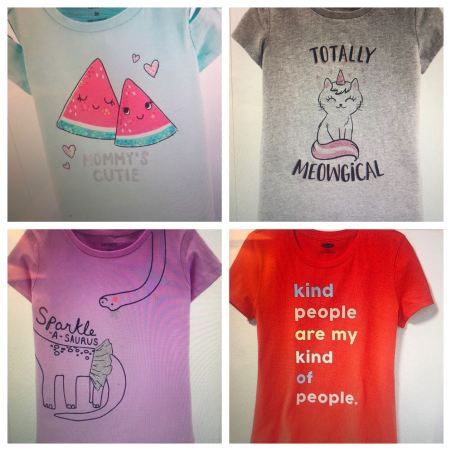
 Other than pirates, male super hero’s, and bugs this is pretty much all you’ll find in the “boy section” of clothing stores:

IMG_2717IMG_2724IMG_2731

Note the different shape (shorter, tighter, bell sleeves) for the “girl section” shirts. There are endless more options not pictured – including tons of empowering messages (“the future is female”) and a huge variety in materials and styles (eg tunics).

This is not normal — this was engineered to make money!

#clothesmatter

#toysmatter too.

Top 5 words used in advertising aimed at girls: magic, hair, fun, sparkle, beautiful

Top 5 words used in advertising for boys: battle, build, blast, control, adventure

Credit: Let Toys Be Toys

#wordsmatter

Thanks for stopping by. Truly, it matters.

~Amanda


International Women’s Day

In honor of International Women’s Day the article Raising Boys Who Respect Women popped up on a page I follow. Of course, I clicked on it. The article offers several suggestions for laying the foundation of boys respecting girls & women.

It opens with, “Experts agree it is never too early to think about parenting children who understand boundaries and respect.” The many conversations happening right now about  sexual harassment and sexual violence against women are an opportunity to create change – the article suggests:

  • Talk about boundaries: “These are the building blocks of how boys consider personal space and boundaries later, said Ted Bunch, chief development officer of A Call To Men, which educates men on healthy, respectful manhood and aims to prevent violence against women.”
  • Model good behavior: highlighting that children learn by observing their parents so share the chores and speak up if someone is being sexist.
  • Make it clear that emotions are OK. “Parents should strive not to reinforce stereotypes that indicate boys are weak if they cry or feel emotions. We want to teach boys to have the full range of emotions, let them cry, let them experience their feelings.” Teaching empathy, the ability to understand others’ feeling is of course a central piece of this.
  • Build up boys. “Boys themselves should feel empowered. Boys who have a good sense of self are less likely to seek fulfillment in unhealthy ways, Rubin said. “We have to raise them to like themselves, and to do that, we have to treat them with love and respect,” he said. “We have to appreciate their uniqueness. We need to validate their feelings; we need to empathize with their pain.” He emphasized that raising boys who like themselves benefits them and others. “When there’s less wounding, there’s less need for compensatory building up of themselves,” he said, whether acting out or acting against others.”

I often say, boys must be given more tools. In reading this article I realize what I should be saying is that parents and other adult role models need to be given tools, so they can support their boys.

“Let

them

experience

their

feelings”

5 words that hold such importance.


Meditation and Therapy

I often talk about our boys needing more supports and tools. A school in Baltimore is offering just that. Check out: Instead of detention, these students get meditation:

“Into a room of pillows and lavender, an elementary school student walks, enraged. He’s just been made fun of by another student, an altercation that turned to pushing and name-calling. But rather than detention or the principal’s office, his teacher sent him here, to Robert W. Coleman Elementary School’s meditation room.


“I did some deep breathing, had a little snack, and I got myself together,” the boy recalled. “Then I apologized to my class.”
Kids here stretch, do yoga and practice deep breathing. More important, staff say, they build an ability to be mindful and calm. And in the face of so much adversity, some of these children are coming out ahead”
Another critical tool — therapy.
Recently in New York City Jumaane Williams won a coveted public advocate seat and in his acceptance speech he talked about openly about mental health:

“I want to speak out on this because it’s important. I’ve been in therapy for the past three years. I want to say that publicly. I want to say that to black men who are listening… There’s a young black boy somewhere. He’s trying to find his space in the world. Nobody knows he cries himself to sleep sometimes. Nobody knows how much he misses his father. Nobody knows what he’s going through. And the world tells him, ‘You have to hide it and you can’t talk about it.’ But I’ve got something to say to that young man that I think about very often. My name is Jumaane Williams and I’m the public advocate of New York City.”

I talk often about the difficulty in being a boy today. Couple this with the toll of racism and microaggressions and Williams speech could not have been more needed. He’s slaying the stigma of seeking professional help and I am grateful for him and his speaking out.